Official Partner of
Laravel

Laravel

Nuxt

Nuxt

Flutter

Flutter

Vue

Vue

vaah<strong>cms</strong>

vaahcms

Multi-Agent Orchestration

Coordinating specialized AI agents into autonomous, deterministic enterprise workflows.
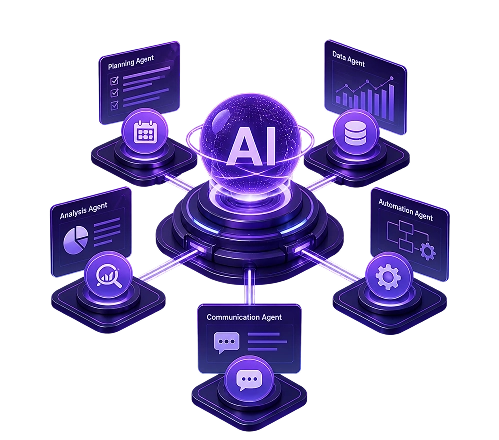
Coordinating specialized AI agents into autonomous, deterministic enterprise workflows.
Specialization. Communication. Consensus. Execution.

The Advantage at a Glance

Production Multi-Agent Orchestration breaks complex enterprise objectives into targeted sub-tasks, delegating them to specialized autonomous agents.

Domain-Specialized Agents

Each agent operates with restricted tools and dedicated domain prompts.

Stateful Graph Orchestration

Persistent graph memory tracks plan progression, agent handoffs, and execution state.

Human-in-Loop Guardrails

Configurable pause points allow human operators to review and approve critical decisions.

Parallel Task Execution

Execute long-horizon multi-step workflows simultaneously across agent swarms.

The Outcomes

Measurable operational advantages delivered through multi-agent orchestration.

10x Task Complexity Handling

Execute long-horizon multi-step workflows impossible for single prompts.

95%+ Output Precision

Dedicated critic and evaluation loops catch hallucinations prior to output generation.

Human-in-the-Loop Safety

Configurable pause points allow human operators to review and approve critical agent decisions.

Fault-Tolerant Execution

Agent failure fallback paths retry, re-route, or re-plan without failing the entire system.

The Agent Framework Stack

Frameworks, state engines, and observability platforms for building production-grade multi-agent systems.

LangGraph & LangChain

Stateful cyclic graph engines for managing complex multi-agent handoffs, persistence, and state synchronization.

Microsoft AutoGen

Multi-agent conversation framework for enabling multi-agent conversation, negotiation, and collaborative problem-solving.

CrewAI

Role-playing, autonomous agent framework for structuring task delegation, agent tools, and execution sequences.

Vector Databases (Pinecone / Weaviate)

Semantic memory layers for retrieving context, documents, and historical inter-agent dialogue.

Ollama & vLLM

High-throughput local and private LLM serving infrastructure for low-latency multi-agent inference.

LangSmith & PromptLayer

Tracing, evaluation, and observability platforms for monitoring multi-agent step executions and token usage.

How the Multi-Agent Lifecycle Works

From goal deconstruction to consensus delivery — the four stages of stateful agent orchestration.

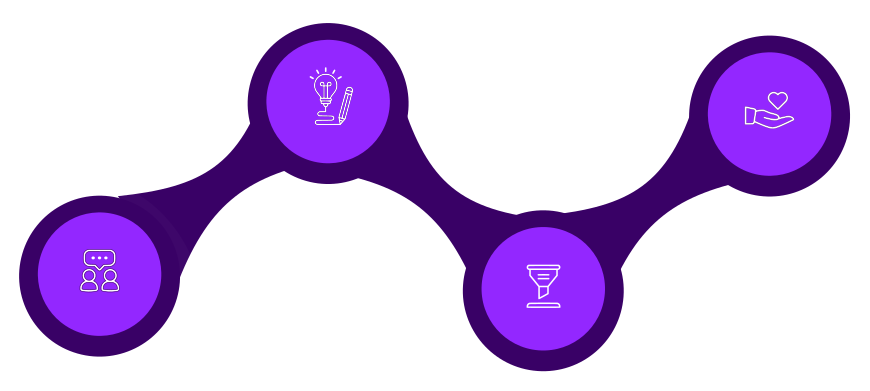
Planning

The supervisor agent decomposes goals into an actionable DAG.

Agent Dispatch

Tasks dispatched to specialized agents with relevant tools and context.

Execution

Agents execute tools, refined by a Critic.

Delivery

Verified outputs update the shared state graph in one payload.

Core Multi-Agent
Solutions

Enterprise Multi-Agent Orchestration automates intricate, cross-functional business pipelines.

Automated Software Engineering

Collaborative agent swarms designing, writing, testing, and reviewing production code.

Market & Data Research

Multi-agent synthesis collecting web data, evaluating sources, and generating structured reports.

Document Auditing

Parallel agents parsing clauses, cross-referencing legal compliance, and flagging risk points.

Supply Chain Planning

Specialized agents optimizing routes, managing inventory thresholds, and coordinating vendor SLAs.

Autonomous Security Auditing

Vulnerability scanning agents collaborating with remediation and patch-verification agents.

Cross-System Automation

Orchestrating disparate SaaS tools, databases, and APIs without manual glue code.

The Single-Agent Limit

Single prompts fail at complex tasks. Multi-agent orchestration fixes this by delegating sub-tasks to specialized agents.

✕

Without Multi-Agent Orchestration

✕ Context Window Saturation — Massive prompts overload model attention, causing hallucinations
✕ Tool Conflicts & Overload — Too many tools in one prompt leads to incorrect function calls
✕ Lack of Self-Correction — Single-pass generation cannot detect intermediate reasoning errors
✓

Multi-Agent Systems Deliver

✓ Segmented context windows keep local memory clean and focus agents strictly on current sub-tasks
✓ Restricted agent tooling prevents function misfires by assigning specific API capabilities per agent role
✓ Built-in critic and evaluation loops review intermediate outputs to catch errors before final synthesis

"Complexity is managed through division of labor—for human organizations and AI systems alike."

Got questions? We've got answers.

Quick insights into Multi-Agent Orchestration Systems.

Multi-Agent Orchestration is an architectural paradigm where multiple specialized AI agents work together—sharing state, using distinct tools, and reviewing each other's work—to complete complex, multi-step tasks.
0+Years of experience
0+Brands Transformed
0%Client Satisfaction
0°Brand Alignment
webreinvent web reinvent